
-
Out of stock
 Memoirs of Cardinal Dubois | translated from the French by Ernest Dowson | with photogravure portraits of Cardinal Dubois and the Duc d'Orleans (Leonard Smithers and Co, London, 1899, First Edition thus, first English translation) 9.75"x6.5", 2 volumes, xvi-282pp, viii-268pp, blue boards with gilt decoration and titles on spine, deckled edges, good condition, bumping to corners, bookplates for Reginald Dalton Pontifex in both volumes. According to the publisher, the original manuscript which was written entirely in Dubois hand was stolen by his secretary Lavergne after his death in 1723. It was later discovered of its literary value that Lavergne attempted to sell the manuscript. He was found and arrested. They later fell into the hands of Comte de Maurepas, then upon his death they were passed on to an anonymous writer named Mercier (possibly M. Paul Laroix) whose family had it published in 1829. The manuscript then became lost. In 1899 and English version of the book translated by Ernest Christopher Dowson, was published by the notorious pornographer, Leonard Smithers & Co. This is, presumably a reprinting of that translation. Guillaume Dubois (1656-1723), a son of a country doctor, rose from humble beginnings to positions of power and high honor in government and in the Catholic Church. He is best known for negotiating the Triple Alliance of 1717 between France, the Dutch Republic and Great Britain against their mutual enemy, Spain. Considered one of the four great French Cardinal-Ministers (Richelieu, Mazarin, Dubois, and Fleury). His ecclesiastical career left a great deal to be desired. Although there is no proof of the prevalent assertion that he got secretly married, his licentiousness, and notorious impiety, even at the time of his death, make it evident that he pursued and used ecclesiastical dignities principally to enhance his political position and prestige. Eventually in 1721, Du Bois was created cardinal. He had the reputation of a libertine and adventurer and made plenty of enemies. One of his rivals was charged at creating his portrait, the Duc de Saint-Simon, who was said to have placed a painting of Dubois in his lavatory. Saint-Simon had this to say about the Cardinal: "He was a little, pitiful, wizened, herring-gutted man, in a flaxen wig, with a weasel's face, brightened by some intellect. All the vices - perfidy, avarice, debauchery, ambition, flattery - fought within him for the mastery. He was so consummate a liar that, when taken in the fact, he could brazenly deny it. Even his wit and knowledge of the world were spoiled, and his affected gaiety was touched with sadness, by the odour of falsehood which escaped through every pore of his body." This famous picture is certainly biased. Dubois was unscrupulous, but so were his contemporaries, and whatever vices he had, he forged a European peace that, with the exception of small, restrained military expeditions against the Austrian Habsburgs, would last for a quarter of a century. Leonard Smithers (1861-1907), a solicitor born in Sheffield, was one of the most notable publishers of erotica of his day. He was said to be a brilliant but shady character who operated on the fringes of the rare book trade, issuing small, clandestine editions of risqué books with the boast: 'I will publish the things the others are afraid to touch'. He was notorious for posting a slogan at his bookshop in Bond Street reading "Smut is cheap today". He developed a friendship with Sir Richard Francis Burton and published Burton's famous translation of the Book of One Thousand and One Nights in 1885. He also worked with, among others, Aubrey Beardsley, Aleister Crowley, and Oscar Wilde. With Beardsley and Arthur Symons, he founded The Savoy, a periodical which ran for eight issues in 1896. Smithers famously partnered with Harry Nichols to publish a series of pornographic books under the Erotika Biblion Society imprint. When Beardsley, on his death bed, converted to Catholicism and asked Smithers to “destroy all copies of Lysistrata and bad drawings...by all that is holy all obscene drawings.", Smithers, famously and thankfully ignored him and continued to publish his works until his death in 1907. It was Smithers who published Oscar Wilde's The Ballad of Reading Gaol, a long poem commemorating the harsh rhythms of prison life in 1898. Smithers went bankrupt in 1900 and died impoverished in 1907 from cirrhosis of the liver. Up until his death he continued to sell reproductions (and forgeries) of Beardsley's work as well as reproductions of the Beardsley's letter asking him to destroy his drawings. Reginald Dalton Pontifex (1857–1951) was born in France, attended Magdalen College at Oxford from 1876–80, getting a Fourth in Law in 1880 and a Third in his BCL in 1882. He later practiced as a barrister. At the time of his death it was said he had quite the book collection containing, several of antiquarian interest. He bequethed his book collection to his alma mater. Most of his books were printed in the early nineteenth century and many of them extensively illustrated. He died in Bournemouth, Hampshire, England in 1951.
-

 The Illustrated Fanny Hill, John Cleland, illustrated by Zevi Blum, introduction written by Erica Jong, designed by Herb Lubalin (The Erotic Artbook Society [Ralph Ginzburg], 1978, first edition thus, stated "NE PLUS EDITION") 12.5" X 10.5", 127pp, hardbound with DJ, very good condition, minor tears to dust jacket Written while the author was in debtor's prison in London and first published in 1748, Fanny Hill is considered the first original English prose pornography, and the first pornography to use the form of the novel. One of the most prosecuted and banned books in history, it has become a synonym for obscenity. Dust Jacket shows some wear but in good condition. This copy is an excellent and beautiful "legal" (meaning post-1966 Supreme Court Case) edition of Fanny Hill. It was published by Ralph Ginzburg (Eros Magazine, Fact Magazine, served 8 months of a 5 year prison term for obscenity). The illustrations are beautifully done and have a psychedelic feel to them.
-
Out of stock

 Naughty Treasury of Classic Fairy Tales, "Translated from the Old Saxon and Illustrated by Sir Rod Q. M'Gurk, Knight of the Brush (np, nd c. 1975) 8.5"x11", 96pp (unpaginated), soft covers, good condition, some minor bumping to corners, near fine internal pagesI've been able to find a few references to this book and very little about "Sir Rod Q. M'Gurk". He apparently also had his cartoons published in Swank magazine c. 1976-7. Eventually it came to the attention of some illustrators and (with help of former Disney animators) was made into a movie by Don Jurwich (not sure the connection between him and Sir Rod Q. M'Gurk, but I'd love to know if it was him).
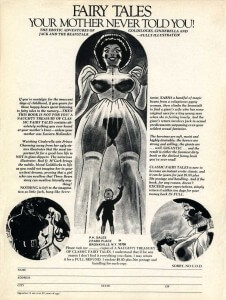
Ad from a "men's magazine" featuring the Naughty Fairy Tales
-
Out of stock

 Thais, Anatole France, trans. Robert B. Douglas, illus. by Martin van Maële (Charles Carrington, London, 1901 [first english translation, first edition, limited edition, one of 500]) 6"x9", x+304pp, hardbound, blue moire silk boards with blind stamped borders, gilt titles on spine, deckled edges, Van Gelder hand-made paper, beautiful tipped-in illustrations protected by tissue guard and printed in combination of black & brown ink, good condition, bumping to corners, some sunning to spine, slight foxing to prelims, interior pages clean Thaïs is a novel by French writer Anatole France, published in 1890 and considered one of his best works. It is based on events in the life of Saint Thaïs of Egypt, a legendary convert to Christianity who is said to have lived in the 4th century. In the story, Paphnuce, an ascetic hermit of the Egyptian desert, journeys to Alexandria to find Thais, the libertine beauty whom he knew as a youth. Masquerading as a dandy, he is able to speak with her about eternity; surprisingly he succeeds in converting her to Christianity. Yet on their return to the desert he becomes fascinated with her former life. She enters a convent to repent of her sins. He cannot forget the pull of her famous beauty, and becomes confused about the values of life. Later, as she is dying and can only see heaven opening before her, he comes to her side and tells her that her faith is an illusion, and that he loves her. Anatole France (François-Anatole Thibault 1844-1924) was a French poet, journalist, and novelist. He was a successful novelist, with several best-sellers. Ironic and skeptical, he was considered in his day the ideal French man of letters. He was a member of the Académie française, and won the 1921 Nobel Prize in Literature "in recognition of his brilliant literary achievements, characterized as they are by a nobility of style, a profound human sympathy, grace, and a true Gallic temperament". France is also widely believed to be the model for narrator Marcel's literary idol Bergotte in Marcel Proust's In Search of Lost Time. Maurice François Alfred Martin van Miële (1863-5 - 1926), better known by his pseudonym Martin van Maële, was a French illustrator of early 20th century literature. Though he gained notoriety with his illustration for H. G. Wells in Les Premiers Hommes dans la Lune, and he worked as an illustrator for the Félix Juven's French translations of the Sherlock Holmes series, he is now most widely renowned and mostly remembered for his erotic illustrations.


This is a store for those who prefer the old to the new;
who prefer character to shine;
who value owning and using a piece of history.
This is a store for those people and the ones who adore them.
