
-
 Die Abenteuer des Chevalier Faublas | Erzählt von Louvet de Couvray [[The adventures of the Chevalier Faublas | Told by Louvet de Couvray], etchings by Karl Walser (Georg Müller, Munich, 1910, #1411/1500) 8.25"x5.5", 4 volumes, x+216pp, 279pp, 295pp, 344pp, half calf over decorated silk (from a drawing by Karl Walser), black title and vol. label with gilt lettering and decorations on spine, 4 etched title vignettes and 12 toned etchings by Karl Walser on 12 panels with green tissue guard, ribbons present in all volumes, good+ condition. Karl Walser (1877-1943) was a Swiss painter, set designer and illustrator. His artwork, although very popular during his lifetime, has mostly been forgotten by the art world, unlike his brother, author Robert Walser, who was never able to support himself through writing which gained notoriety after his death. Jean-Baptiste Louvet de Couvrai (1760 - 1797) was born in Paris as the son of a stationer, he became a bookseller's clerk, and first attracted attention with the first part of his novel "Les Amours du chevalier de Faublas" (5 parts) in 1787; it was followed in 1788 by "Six semaines de la vie du chevalier de Faublas" (8 parts) and in 1790 by "La Fin des amours du chevalier de Faublas" (6 parts). The heroine, Lodoiska, was modeled on the wife of a jeweler in the Palais Royal, with whom he had an affair. She divorced her husband in 1792 and married Louvet in 1793. This is considered a so-called "libertine" novel. It dwells mainly on the sexual escapades of its hero, a sort of amiable young libertine, and on the corrupted morals of eighteenth-century France. At the start of this novel the young Chevalier de Faublas attends a party dressed as a woman and is knowingly seduced by the lady of the house ('. I receive with equal astonishment and pleasure a charming lesson, which I repeated more than once .') Oxford Comp. to French Literature says it is "typical of many frivolous, licentious novels of its time, and still mentioned. Faublas, the amiable hero, is the victim of his own charms. His amorous adventures, recounted with a certain lively force, begin with his entry into society at the age of sixteen. He loves several women by the way and three in particular. A jealous husband and a despairing suicide reduce the three to one. The novel ends on a moral note: Faublas , who had happened to settle down with his remaining love, is haunted by the avenging phantoms of the other two and goes mad."
-
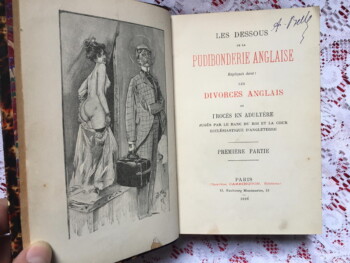
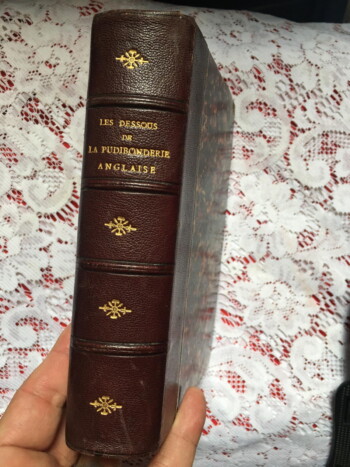 Les dessous de la pudibonderie anglaise expliqués dans les divorces anglais, ou procès en adultère jugés par le banc du Roi et la Cour Ecclésiastique d'Angleterre [trans. The Basics of English Prudishness Explained in English Divorces, or Adultery Trial Judged by the King's Bench and the Ecclesiastical Court of England], anonymous [most like Carrington himself as editor/compiler], illustrations Jacques Wely (Charles Carrington, Paris, 1898, first edition) 7.5"x5", 2 volumes in one, xxiv-108, xxx-287-xii, quarter morocco over marbled boards, 4 raised bands, gilt titles and decoration on spine, marbled endpapers, great condition, previous owners name on title page, some bumping to corners. According to the British Library this is a compilation of entries from "Trials for Adultry" [Trials for Adultery: or, the History of Divorces. Being Select Trials at Doctors Commons, for Adultery, Cruelty, Fornication, Impotence, &c. From the Year 1760, to the present Time. Including the whole of the Evidence on each Cause. Together with The Letters, &c. that have been intercepted between the amorous Parties… Taken in Short-Hand , by a Civilian. London: Printed for S. Bladon, 1779-1780] which, as the full title suggests, is considered one of the Earliest of "The Genre of Pornographic Trial Reports". Also present are excerpts from some English plays. According to Yale, this compillation also "Contains case histories from: Crim. con. biography attributed to Francis Plowden." London, 1798. Criminal conversation, commonly known as crim. con., is a tort arising from adultery, abolished in almost all jurisdictions. (Conversation is an old expression for sexual intercourse that is obsolete except as part of this term.) As far as we can tell, this is a book compiled and edited by Carrington. Carrington himself was an Englishman, a Londoner who was married to a woman from France. He published this book a few years after the couple left London and moved to Paris, presumably so he would have more freedom to publish books that London would have no doubt considered pornography. This book is a case study of the prudishness of the English and it uses salacious material taken from various sources listed above to prove the point.
-
Memoirs of Fanny Hill, John Cleland (Privately Printed, The Kamashastra Society, 1907 [likely pirated copy of the Paris Kamashastra edition, likely clandestinely printed in the US, c. 1920-30s]) 8.75" X 5.75", 287pp, hardbound no DJ, top edge dyed blue, fair condition, binding good, boards are loose but holding. Written while the author was in debtor's prison in London and first published in 1748, Fanny Hill is considered the first original English prose pornography, and the first pornography to use the form of the novel. One of the most prosecuted and banned books in history, it has become a synonym for obscenity. The title page is printed in black with green decorations. The contents mirror the Carrington versions of the book, reformatted and lacking the plates. The title is in black (not black and green as other Kamashastra editions) This leads me to believe that it is a likely US pirate of the Kamashastra (which is, itself a pirate of the Carrington version).
-
Out of stock

 2.25" x 2.75" Shackle Antique hand-forged iron shackles from a farm in Bulgaria. They have been cleaned up and seasoned much like you'd season your cast iron skillet (repeatedly coated with oil and baked). No key is needed as they lock using a puzzle design.
-

 2.5" x 3" Shackle with ring Antique hand-forged iron shackles from a farm in Bulgaria. They have been cleaned up and seasoned much like you'd season your cast iron skillet (repeatedly coated with oil and baked). No key is needed as they lock using a puzzle design.
-
 2.75" x 3.75" Shackle Antique hand-forged iron shackles from a farm in Bulgaria. They have been cleaned up and seasoned much like you'd season your cast iron skillet (repeatedly coated with oil and baked). No key is needed as they lock using a puzzle design.
-
 3" x 3.5" Shackle with ring Antique hand-forged iron shackles from a farm in Bulgaria. They have been cleaned up and seasoned much like you'd season your cast iron skillet (repeatedly coated with oil and baked). No key is needed as they lock using a puzzle design.
-
 3.5" x 3.25" Shackle Antique hand-forged iron shackles from a farm in Bulgaria. They have been cleaned up and seasoned much like you'd season your cast iron skillet (repeatedly coated with oil and baked). No key is needed as they lock using a puzzle design.
-
 3" x 3.5" Old Shackle with ring Antique hand-forged iron shackles from a farm in Bulgaria. They have been cleaned up and seasoned much like you'd season your cast iron skillet (repeatedly coated with oil and baked). No key is needed as they lock using a puzzle design.
-

 2.5" x 3" Old Shackle with ring Antique hand-forged iron shackles from a farm in Bulgaria. They have been cleaned up and seasoned much like you'd season your cast iron skillet (repeatedly coated with oil and baked). No key is needed as they lock using a puzzle design.
-

 3" x 3" Shackles (matched pair, no rings) Antique hand-forged iron shackles from a farm in Bulgaria. They have been cleaned up and seasoned much like you'd season your cast iron skillet (repeatedly coated with oil and baked). No key is needed as they lock using a puzzle design.
-

 (2 x 2") + (2 3/4 x 3 1/4") Shackles (matched pair ankle/wrist) Antique hand-forged iron shackles from a farm in Bulgaria. They have been cleaned up and seasoned much like you'd season your cast iron skillet (repeatedly coated with oil and baked). No key is needed as they lock using a puzzle design.
-
 3" x 3.5" Shackles (matched pair) Antique hand-forged iron shackles from a farm in Bulgaria. They have been cleaned up and seasoned much like you'd season your cast iron skillet (repeatedly coated with oil and baked). No key is needed as they lock using a puzzle design.
-

 Fitzgerald Mfg. Co., works
 c. 1927 Actress Colleen Moore using a Star-Rite electric massage vibrator in Hollywood.
-
Out of stock

 Venus in Furs, Leopold von Sacher-Masoch, illustrated by Charles Raymond [trans. Fernanda Savage] (Privately Printed For Subscribers Only, New York, 1928) 218pp, hardbound with slipcase, blue faux sued boards, white spine with gilt titles, deckled edges, dark blue slipcase with orange title on spine, very good condition for age, slipcase bumps and rubbing repair to bottom of spine, book clean, pages in unread condition with some remaining uncut Venus in Furs (German: Venus im Pelz) is a novella by Leopold Ritter von Sacher-Masoch (1836-1895), an Austrian writer and journalist. It is now his best known work and because of its themes the term masochism is derived from his name, coined by the Austrian psychiatrist, Krafft-Ebing. The novel was to be part of an epic series that Sacher-Masoch envisioned called Legacy of Cain. Venus in Furs was part of Love, the first volume of the series. It was published in 1870. The novel draws themes, like female dominance and sadomasochism, and character inspiration heavily from Sacher-Masoch's own life. Wanda von Dunajew, the novel's central female character, was modelled after his mistress Baroness Fanny Pistor. In December 1869 the two signed a contract making him her slave for a period of 6 months. In 1873, after the publication of Venus in Furs, Sacher-Masoch married Aurora von Rümelin who he pressured to continue the lifestyle he wrote about in his book. After 10 years they divorced. Rümelin, using the pseudonym of the books title character, "Wanda von Dunajew", wrote Meine Lebensbeichte (My Life Confession) published in 1906. It detailed Sacher-Masoch's private life and her relationship with him. During his lifetime, Sacher-Masoch was well known as a man of letters, a utopian thinker who espoused socialist and humanist ideals in his fiction and non-fiction. Most of his works remain untranslated into English. Until recently, his novel Venus in Furs was his only book commonly available in English.
-

 <strong>The Kama Sutra of Vatsyayana | Translated from the Sanscrit by The Hindoo Kama Shastra Society | Complete in seven parts with Preface, Introduction, and Concluding Remarks | Illustrated</strong>, by Vatsyayana (Printed for the Society of the Friends of India 1883-1925, Benares-New York, one of 800, unnumbered) <em>6"x9", xxi+175pp, hardbound, blue boards, hand laid paper, top-edge gilt, others deckled, 8 B/W half-tone reproductions of erotic Hindu stone-sculptures with tissue guards, soiling on boards, inner pages are clean, binding is good.</em> Attributed to ancient Indian philosopher Vatsyayana, the Kama Sutra is generally believed to have been composed between 400 and 200 B.C.E. Although a portion of the work consists of practical advice on sexual intercourse, the work is primarily prose consisting of 1250 verses distributed over 36 chapters structured into seven parts. This book lists those parts as: Part I. Index, and General Consideration of the Subject Part II. Of Sexual Union Part III. About the Acquisition of a Wife Part IV. About a Wife Part V. About the Wives of Other People Part VI. About Courtezans Part VII. On the Means of Attracting Others to Oneself
-
Out of stock

 Thais, Anatole France, trans. Robert B. Douglas, illus. by Martin van Maële (Charles Carrington, London, 1901 [first english translation, first edition, limited edition, one of 500]) 6"x9", x+304pp, hardbound, blue moire silk boards with blind stamped borders, gilt titles on spine, deckled edges, Van Gelder hand-made paper, beautiful tipped-in illustrations protected by tissue guard and printed in combination of black & brown ink, good condition, bumping to corners, some sunning to spine, slight foxing to prelims, interior pages clean Thaïs is a novel by French writer Anatole France, published in 1890 and considered one of his best works. It is based on events in the life of Saint Thaïs of Egypt, a legendary convert to Christianity who is said to have lived in the 4th century. In the story, Paphnuce, an ascetic hermit of the Egyptian desert, journeys to Alexandria to find Thais, the libertine beauty whom he knew as a youth. Masquerading as a dandy, he is able to speak with her about eternity; surprisingly he succeeds in converting her to Christianity. Yet on their return to the desert he becomes fascinated with her former life. She enters a convent to repent of her sins. He cannot forget the pull of her famous beauty, and becomes confused about the values of life. Later, as she is dying and can only see heaven opening before her, he comes to her side and tells her that her faith is an illusion, and that he loves her. Anatole France (François-Anatole Thibault 1844-1924) was a French poet, journalist, and novelist. He was a successful novelist, with several best-sellers. Ironic and skeptical, he was considered in his day the ideal French man of letters. He was a member of the Académie française, and won the 1921 Nobel Prize in Literature "in recognition of his brilliant literary achievements, characterized as they are by a nobility of style, a profound human sympathy, grace, and a true Gallic temperament". France is also widely believed to be the model for narrator Marcel's literary idol Bergotte in Marcel Proust's In Search of Lost Time. Maurice François Alfred Martin van Miële (1863-5 - 1926), better known by his pseudonym Martin van Maële, was a French illustrator of early 20th century literature. Though he gained notoriety with his illustration for H. G. Wells in Les Premiers Hommes dans la Lune, and he worked as an illustrator for the Félix Juven's French translations of the Sherlock Holmes series, he is now most widely renowned and mostly remembered for his erotic illustrations.
-

 Fanny Hill print 5.5 x 8.25" This print came from someone's private collection. The rest of the prints I have from this estate are also from various editions of Fanny Hill by John Cleland. Print is by "PIZAN" and is possibly from a 20-30s edition printed clandestinely in NY.
-

 Fanny Hill print 5.5 x 8.25" This print came from someone's private collection. The rest of the prints I have from this estate are also from various editions of Fanny Hill by John Cleland. Print is by "PIZAN" and is possibly from a 20-30s edition printed clandestinely in NY.
-
Out of stock

 Fanny Hill print 5.5 x 8.25" This print came from someone's private collection. The rest of the prints I have from this estate are also from various editions of Fanny Hill by John Cleland. Print is by "PIZAN" and is possibly from a 20-30s edition printed clandestinely in NY.
-

 Fanny Hill print 5.5 x 8.25" This print came from someone's private collection. The rest of the prints I have from this estate are also from various editions of Fanny Hill by John Cleland. Print is by "PIZAN" and is possibly from a 20-30s edition printed clandestinely in NY.
-

 Fanny Hill print 5.5 x 8.25" This print came from someone's private collection. The rest of the prints I have from this estate are also from various editions of Fanny Hill by John Cleland. Print is by "PIZAN" and is possibly from a 20-30s edition printed clandestinely in NY.
-

 Fanny Hill print "Then, taking the fine handle that so invitingly offered itself, she led the youth to the bed." 6 x 8" This print came from someone's private collection. The rest of the prints I have from this estate are also from various editions of Fanny Hill by John Cleland. I'm unsure of the edition but this seems to be a print from the 1920-30s.
-
Out of stock

 Fanny Hill print "Kissing me in every part, the most secret one so far excepted that it came in for most of that homage." 6 x 8", hand colored This print came from someone's private collection. The rest of the prints I have from this estate are also from various editions of Fanny Hill by John Cleland. I'm unsure of the edition but this seems to be a print from the 1920-30s and hand colored.
-
The Love Books of Ovid, A Completely Unexpurgated and Newly Translated Edition by Charles D. Young | Together with the Elegie, Translated by Christopher Marlowe | Illustrated by Alexander King "This book, designed by T. Spencer Hutson, was printed at the Alexander Hamilton Press, in March 1930. Illustrations are reproduced by the Knudson process. This edition consists of Two Thousand numbered copies printed on Strathmore MELDON deckle edge laid paper. This copy is No. 361" (Privately Published for Subscribers, Art Studio Books, Inc., 1930, #361/2000) 6.25"x9.5", iii+302pp, 3/4 black cloth over marbled boards, gilt text and decorations on spine, gilt borders on covers, marbled pastdowns, top edge gilt, other edges deckled, frontispiece and 16 full-page illustrations with descriptive tissue guards, other illustrations and titles in orange within text, near fine copy, slight rubbing at top and bottom of spine. This is a beautiful edition of 5 of his works, Ars Amatoria ("The Art of Love"), Remedia Amoris ("The Cure for Love"), Amores ("The Loves"), Medicamina Faciei ("dye on the face"), and his Elegies Publius Ovidius Naso (43 BC – AD 17/18), known as Ovid in the English-speaking world, was a Roman poet who lived during the reign of Augustus. He was a contemporary of the older Virgil and Horace, with whom he is often ranked as one of the three canonical poets of Latin literature. The Imperial scholar Quintilian considered him the last of the Latin love elegists. He enjoyed enormous popularity, but, in one of the mysteries of literary history, was sent by Augustus into exile in a remote province on the Black Sea, where he remained until his death. Ovid himself attributes his exile to carmen et error, "a poem and a mistake", but his discretion in discussing the causes has resulted in much speculation among scholars. The first major Roman poet to begin his career during the reign of Augustus, Ovid is today best known for the Metamorphoses, a 15-book continuous mythological narrative written in the meter of epic, and for works in elegiac couplets such as Ars Amatoria ("The Art of Love") and Fasti. His poetry was much imitated during Late Antiquity and the Middle Ages, and greatly influenced Western art and literature. The Metamorphoses remains one of the most important sources of classical mythology. Alexander King (1899–1965), born Alexander Koenig in Vienna, was a bestselling humorist, memoirist and media personality of the early television era, based in the United States. In his late fifties, after becoming a frequent guest on the a Tonight Show hosted by Jack Paar, King emerged as an incongruous presence in the realm of national celebrity: an aging, irascible raconteur, with elegant mannerisms and trademark bow-tie, who spoke frankly and disarmingly about his bohemian lifestyle, multiple marriages, and years-long struggle with drug addiction. His checkered past led TIME magazine to describe him as "an ex-illustrator, ex-cartoonist, ex-adman, ex-editor, ex-playwright, ex-dope addict. For a quarter-century he was an ex-painter, and by his own bizarre account qualifies as an ex-midwife. He is also an ex-husband to three wives and an ex-Viennese of sufficient age (60) to remember muttonchopped Emperor Franz Joseph. When doctors told him a few years ago that he might soon be an ex-patient (two strokes, serious kidney disease, peptic ulcer, high blood pressure), he sat down to tell gay stories of the life of all these earlier Kings."
-
Out of stock

 White Rebenque 23" long, flap is 12", white leather with rawhide/sinew stitching and decorations, slight yellowing from age. Beautiful hand-made white leather rebenque 50+ years old. It has decorative rawhide work on the handle and on the strap, using two colors of rawhide. The handle is textured by wrapping a wet cord around it, leaving an imprint on the leather. Rebenque is the name in Brazilian Portuguese for a type of whip used by gauchos in South America. Especially in Argentina, it is the traditional riding, fighting, and punishing whip of the gaucho. It consists of a rawhide wrapped wooden handle with a thong made of a leather strap a little longer than the handle. The wide strap made the rebenque an instrument less severe on the horse than the European riding crop. As the gaucho was never far from the horse, the rebenque was always on him. When not in use, he made a knot with the strap and held the rebenque lazily by the wrist strap with the middle fingers of his hand, or hung it from the handle of his facón knife (as he used the large knife almost horizontally at his back, held by the belt or waistband, the handle protruded from his right side). The rebenque was used also for fighting, as a weapon by itself, when the fight did not merit a knife, or with the strap rolled on his left hand and the handle hanging, as a secondary weapon to the knife in his right hand. Of course, it was also used for domestic punishments, and for quasi-judicial chastisement. A couple of lashes with the rebenque on the bare legs were widely used as a punishment for children, even in the urban areas.
-
Out of stock

 Fid from India 13.5" long, 1.5" at widest part, unknown wood, with original rope A fid is a conical tool made of wood or bone. It is used to work with rope and canvas in seamanship. A fid is used to hold open knots and holes in canvas or to open the "lays", or strands of rope, for splicing.
-

 La Grande Diablerie, poem du XVe siècles, by Éloy d'Amerval (George Hurtrel, Artiste-Édueur, Paris, 1884, #152/1000 hand signed by publisher) 5" x 6.75", 216pp, in original published state, french wraps with loose hardcover/case, red with gilt decoration, frontispiece and 3 full page engravings by Paul Avril protected by tissue guard, images throughout, good minus condition, spine cover is sunned, binding is loose and splitting in places Eloy d'Amerval (fl. 1455 – 1508) was a French composer, singer, choirmaster, and poet of the Renaissance. He spent most of his life in the Loire Valley of France. From his poetic works, the long poem Le livre de la deablerie, it can be inferred that he knew most of the famous composers of the time, even though his own musical works never approached theirs in renown. This poem, considered invaluable to music historians, recounts a dialogue between Satan and Lucifer, in which their nefarious plotting of future evil deeds is interrupted periodically by the author, who among other accounts of earthly and divine virtue, records useful information on contemporary musical practice. In addition to listing musical instruments, he lists who he considers to be the great composers of the time: they are residents of Paradise in his poem, even though several were still alive in 1508, the date of its composition. Édouard-Henri Avril (1849-1928) used the pseudonym “Paul Avril” for his erotic work. He was a French painter and commercial artist. His career saw collaboration with influential people like Octave Uzanne, Henry Spencer Ashbee and Friedrich Karl Forberg. He is one of the most celebrated erotic artists of his age. Avril was a soldier before starting his career in art. He was awarded with the Legion of Honour for his actions in the Franco-Prussian War.
-

 The Tunning of Elynour Rumming, by John Skelton Laureat, "with decorations from the drawings in colour and line by Pearl Binder" (Fanfrolico Press, London, 1928, #433/550 hand written limitation) 7.75" x 11.25", 47pp, hardbound, coarse fiber on boards (burlap?), hand laid paper, artfully done, in good plus condition for age and for the unconventional binding materials The Tunning of Elynour Rummyng is a long raucous poem written by English poet John Skelton(1463-1529). The poem was first printed by Richard Lant sometime in 1550 and presents what many would consider disgusting images of rural drinking and drunkenness. For all its gritty description, Skelton has modeled the poem on Church liturgy of that time. The verse form itself closely resembles a liturgical chant. Elynour is a character in the poem who runs a "public house," or pub. Many pubs in England had the look of a home both inside and out. In the early 16th century, the male or female owner of the pub not only sold the ale, but also probably brewed it. Elynour easily acquires all her ingredients for quite acceptable ale from the local farmers in southern England where her pub was apparently located. Nevertheless, the kind of hard language which is found in the poem, is not uncommon as "bar talk." Today, much like in the 16th century, many brands of beer have been derisively referred to as "pig piss" perhaps because of beer's pale yellowish color and its bland and very slightly bitter taste. The poet says that chickens roost over Elynour's fermentation tank and drop their excrement into the froth. The yeast will sometimes form a white cap on the fermenting beer. Alcoholic beverages are also often associated with sex and indeed will sometimes reduce the inhibitions of men and women. However, Elynour advises her female customers that the ale will make them more desirable to their husbands, in part because she has the chicken excrement in the ale. Fanfrolico Press, Australia’s first ‘private press’ in the arts-and-craft tradition, was founded by Jack Lindsay, P. R. Stephensen and John Kirtley, originally in North Sydney in 1923. The press specialized in printings artful, limited editions of classics and forgotten works that were suited to the extravagant style of artist like his father, artist, sculptor and author Norman Lindsay who illustrated many of their books. Fanfrolico was scornful of modernism and with its florid style determinedly backward-looking. They did surprisingly well, despite the lack of business expertise of their young, ambitious "bohemian" owners, eking out a living despite the risky move to London in 1926 and upheavals in ownership that saw the departure in 1927 of Kirtley, and then Stephenson in 1929. Sometime in 1930 they published their last book.
-

 Stag Night, by Phillips Rogers (Prentice-Hall, Inc, New York, 1946) 6" x 8.5", 230pp, hardcover with DJ, red boards with black titles on spine, DJ in fair shape, yellowing throughout, binding good [from Dust Jacket] "Stag Night is a revealing novel about an affair that the men reminisce over for a year and their wives wonder about--the annual Gentleman's Dinner at a country club." "The entire action of Stag Night takes place in one evening at a country club. It begins with the arrival of a tightly girdled whisky-loving Mrs. Riordan ("Fatima") who has for many years given her Dance of the Seven Veils at the Gentleman's Dinner. It ends with tactful and wise Heinz, the head waiter, bidding the police goodnight. In between is depicted the frenzied activity of the chef and the dour bartender, the ribald behavior of some of the stags, the bewilderment of an innocent young refugee dancer, and the mounting excitement as the moment nears for the showing of lewd movies. Tragedy in a grotesque form stalks the evening and at the climax the diners receive the surprise of their lives — and we don't mean the cops in the hall."
-
Out of stock

 Louisville Slugger Softball Bat 33", 2.5" wide "Louisville Slugger | 1255 | Hillerich & Bradsby | Made in USA | Louisville, KY | Powerized"
-

 Louisville Slugger 125Y, Hillerich & Bradsby Co 33.25", 1.75 wide, tape on handle has been removed. States "Louisville Slugger 25Y, Hillerich & Bradsby Co, Made in the USA, Louisville, KY" "Heartwood" "Official Thin Grip Softball Model 12"
-

 Spalding Softball Bat 33", 2" wide, in rough condition, handle and tip chipped/gouged states "Soft Ball | Spaulding Trade Mark | No. S | Air Dried | Made in Canada"
-

 Hillerich & Bradsby JL H&B Softball Bat 31", 2" wide "Made in US | Louisville, KY | It's a Louiville"
-

 Tales of Firenzuola | Benedictine Monk of Vallombrosa | (XVIth century) | first time translated into English, Agnolo Firenzuola (Isidore Liseux, Paris, 1889) 4.25" x 6.5", xix+180pp., full soft red morroco binding with gilt borders, decorated end papers, deckled edges, hand laid paper, unique frontispiece illustration tipped in, not seen in any other copies online, title page in red and black, good minus condition, corners bumped top of spine is torn, .5" inch of bottom of spine is missing This copy is a rare all-leather first-edition. I have not seen any other copies with this frontispiece and know nothing about it's origin. Originally written in Italian titled Ragionamenti Amorosi (Amorous Reasons), the Tales were written in 1523-24 on the Boccaccian premise of a group of young ladies and gentlemen gathered in a Tuscan villa to tell each other, in turn, stories dealing with love, fortune, fate, virtue, etc. The stories themselves, in their variety and immediacy, offer an insight into sixteenth-century Italian society and its concerns. Agnolo Firenzuola (1493–1545), an Italian poet and littérateur, was born in Florence, September 28th, 1493. He received his name from the town of Firenzaola among the Apennines, where his family originated. Agnolo spent his youth in Siena and Perugia, studying law and living a "life of pleasure". For a short time he practiced law in Rome, but abandoned it to become a monk at Vallombrosa. After the death of Clement VII. he went to Florence, and finally settled at Prato as abbot of San Salvatore. Some authorities have disputed that he ever became an abbot, for the records of his dissolute career do not accord with a monastic life. But whether abbot or gentleman of leisure, a severe illness took him to Prato, where he spent many happy years. He died there or at Rome, about 1545. Firenzuola wrote satirical and burlesque poems; two comedies, ‘I Lucidi’ and ‘La Trinuzia’; ‘Discorsi degli Animali,’ imitations of Oriental fables of animals; ‘Ragionamenti Amorosi,’ novelettes or tales after the fashion of Boccaccio; ‘Dialogo della Bellezza delle Donne,’ and other works. He also wrote a few love poems and ballads, one of the most admired of which is ‘Orozza Pastorella.’ Isidore Liseux (1835-1894) was a French bibliophile and publisher of erotica and curiosa. His publications were mostly rare texts of 16th to 18th century authors, hard to find and little known books which were usually translated and annotated by his friend and associate Alcide Bonneau or by Liseux himself. Liseux and Bonneau, both ex-priests, knew each other since seminary. His books were published in small numbers, on high quality paper, and with excellent typography. His usual printers were Claude Motteroz, Antoine Bécus, and later Charles Unsinger. Liseux's books were published openly as the climate was more permissive in Paris at the time. His books were so well regarded that pirates of his books and even unrelated books bearing his imprint with a false date were published clandestinely into the 20th century. French poet, Guillaume Apollinaire wrote: "The publications of Liseux are more and more sought after because they are correct, beautiful and rare." (Le flaneur des deux rives, 1918).
-
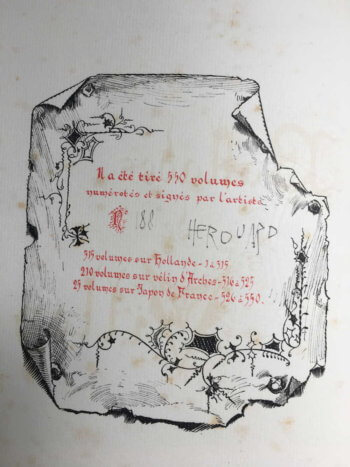
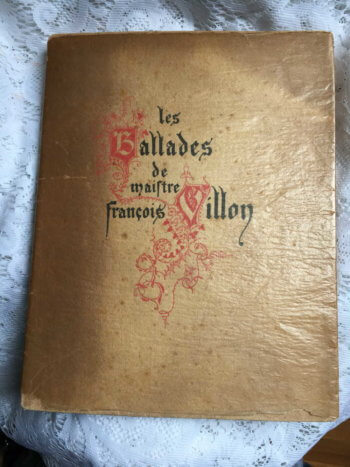 Les Ballades de Maistre Francois Villon, Francois Villon, illus. Chéri Hérouard, caligraphy ["escrites"] by Raymond de Rigné (chez Cres., Paris, 1919, #188/550 signed by Hérouard) 11.75" X 9.25", 169pp, original french wraps with glassine cover, 31 full page drawings by Hérouard plus 31 small vignette type illustrations. Beautifully printed on heavy deckle edged paper. good condition, all original, minor rubbing, slight foxing on outer pages, inner pages clean, rips in glassine cover at top and bottom of spine. François Villon (c. 1431_1464) was a French poet. Most of what is known about Villon has been gathered from legal records and gleaned from his own writings. He was a thief, killer, barroom brawler, and vagabond. He is perhaps best known for his Testaments and his Ballades. He was the most famous realist poet of the Middle Ages. Chéri Hérouard (1881 - 1961) was a French illustrator who was most famously known for his forty-five-year work for French society magazine, La Vie Parisienne. Under the pseudonym of Herric, he also created erotic and sadomasochistic illustrations for various books including the Kama Sutra.
-

 Les infortunes de la vertu, Marquis de Sade, introduction by Jean Paulhan (les editions du point du jour, 1946, "incidences" collection, #908/2000) 5.75" x 7.75", xlii+242pp, softcover "french wraps", good unread condition, many pages remain uncut. This edition appears to represent the original version of Justine that Sade wrote while imprisoned at the Bastille in 1787 (see below). The story is about Justine from age 12 to 26 and recounts all of her attempts to be virtuous no matter what life throws at her. She is constantly presented with sexual lessons hidden under a virtuous mask. She seeks refuge in a monastery but is forced to become a sex slave of the monks. After she helps a gentleman who is robbed in a field, he takes her back to his chateau on the pretext to have her help care for his wife. He confines her in a cave where she is subjected to more punishment. When she goes to a judge to beg for mercy in her case as an arsonist, she then finds herself openly humiliated in court, unable to defend herself. The moral(especially when juxtaposed with the "companion story", Juliette) seems to be that one should not resist a bit of vice if it is for the common good. The more Justine tries to resist temptation and be virtuous the further she was plunged into a life of vice and torture, while Juliette (her sister) submitted to a brief period of debauchery and vice and eventually lived a comfortable, happy existence. The Marquis de Sade wrote the first version of Justine (Les infortunes de la vertu, "The Misfortunes of Virtue") while imprisoned at the Bastille in 1787. In 1791 an expanded and more explicit version became Sade's first published work. In 1797, an even more detailed version was published along with a story of Juliette (Justine's sister) that comprised of 10 volumes and nearly 4000 pages. This final version, "La Nouvelle Justine", departed from the first-person narrative of the previous two versions, and included around 100 engravings. Most editions are taken from that 1797 Holland edition. Napoleon Bonaparte ordered the arrest of the anonymous author of Justine and Juliette, and as a result Sade was incarcerated for the last 13 years of his life. Napoleon called the work "the most abominable book ever engendered by the most depraved imagination". English titles: Justine, or the Misfortune(s) of Virtue; The Misfortunes of Virtue; Justine, or Good Conduct Well Chastised; Justine or Good Conduct Will Be Chastised
-

 The Persecution and Assassination of Jean-Paul Marat as Performed by the Inmates of the Asylum of Charenton under the Direction of the Marquis de Sade, Peter Weiss, English version Geoffrey Skelton, verse adaptation Adrian Mitchell, introduction Peter Brook (Atheneum, New York, 1965, stated first american edition) 5.5"x8.5", x+117pp, hardbound, red boards, silver titles on spine, blind stamped title on cover, top-edge inked, near mint condition This is a 1963 play by Peter Weiss originally published in German under the title Die Verfolgung und Ermordung Jean Paul Marats, dargestellt durch die Schauspielgruppe des Hospizes zu Charenton unter Anleitung des Herrn de Sade, usually shortened to Marat/Sade. This is the first American version, published in 1965. A "play within a play", Merats/Sade incorporates dramatic elements characteristic of both Artaud and Brecht. It is a depiction of class struggle and human suffering that asks whether true revolution comes from changing society or changing oneself. Peter Ulrich Weiss (1916-1982) was a German writer, painter, graphic artist, and experimental filmmaker of adopted Swedish nationality. He earned his reputation in the post-war German literary world as the proponent of an avant-garde, meticulously descriptive writing, as an exponent of autobiographical prose, and also as a politically engaged dramatist. He gained international success with Marat/Sade, the American production of which was awarded a Tony Award and its subsequent film adaptation directed by Peter Brook. His "Auschwitz Oratorium," The Investigation, served to broaden the debates over the so-called "Aufarbeitung der Vergangenheit" (or formerly) "Vergangenheitsbewältigung" or "politics of history." Weiss' magnum opus was The Aesthetics of Resistance, called the "most important German-language work of the 70s and 80s.
-
Out of stock

 Marquis de Sade | The Man and His Age | studies in the history of the culture and morals of the eighteenth century, Dr. Iwan Bloch, translated by James Bruce (Julian Press, 1931, [first american edition]) 6 .5"x9.5", 296pp, hardbound, black boards, red and gilt title on spine, some bumps and wear, good condition for age. Iwan Bloch (1872-1922), the “father of sexology”, was a Berlin dermatologist. His many socio-cultural studies in sexology earned him an international reputation as a medical historian. He also discovered de Sade’s manuscript of the “120 days of Sodom” in 1904, which had been believed to be lost. Together with Magnus Hirschfeld and Albert Eulenburg, Bloch proposed the new concept of a science of sexuality: Sexualwissenschaft or sexology. In 1906 he wrote Das Sexualleben unserer Zeit in seinen Beziehungen zur modernen Kultur [The Sexual Life of our Time in its Relations to Modern Civilization], a complete encyclopedia of the sexual sciences in their relation to modern civilization. According to Sigmund Freud, Bloch's studies were instrumental in the development of the anthropological approach to the theory of sexuality. For example, before Bloch, homosexuality was analyzed using a pathological approach.
-
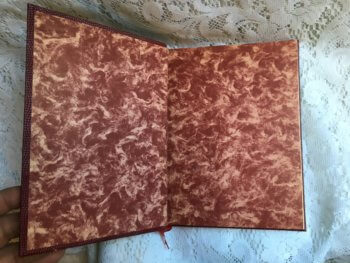
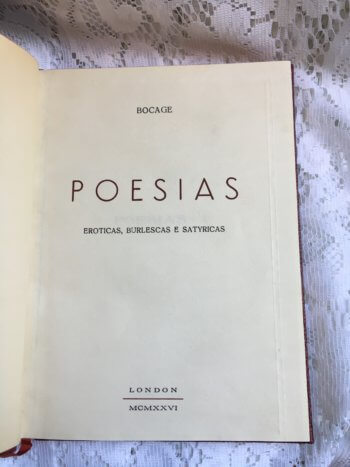 Poesias: eroticas, burlescas e satyricas, Bocage (Manuel Maria Barbosa du Bocage) (np, London, 1926, #443/1000 machine numbered) 6" X 8", 220pp, in Portuguese, hardcover, quarter bound red leather over red pebbled boards, gilt titles and decorations on spine, four raised bands, laid paper, top-edge inked, marbled end papers, ribbon present, a handsome quarter-leather bound copy of a clandestinely published edition of Bocage's unpublishable works. (most copies of this edition are softbound). Manuel Maria Barbosa du Bocage (1765-1805) was a Portuguese Neoclassic poet, writing at the beginning of his career under the pen name Elmano Sadino. He aspired to be a second Camões. He was born, the son of a lawyer, in Setúbal, Portugal. He is said to to have made verses in infancy, and being somewhat of a prodigy grew up to be flattered, self-conscious and unstable. He left home at age 14 to join the army then transfered to the navy at age 16. While in the military he devoted most of his energies to love affairs, poetry, and bohemianism. Eventually, like his hero Camões, he was sent to India and became disillusioned by the Orient. He deserted to Macau, returning to Lisbon in 1790. He then joined the New Arcadia, a literary society with vaguely egalitarian and libertarian sympathies, but his satires on his fellow members resulted in his expulsion. In 1797 he was accused of propagating republicanism and atheism and was imprisoned. During his imprisonment he undertook translations of Virgil and Ovid. Translations provided him with a livelihood during the few years that he lived after his release. Despite the Neoclassical framework of his poetry, his intensely personal accent, frequent violence of expression, and self-dramatizing obsession with fate and death anticipate Romanticism. The subversiveness of his poems has meant that for much of the last 200 years they have not been (officially) available in Portugal.


This is a store for those who prefer the old to the new;
who prefer character to shine;
who value owning and using a piece of history.
This is a store for those people and the ones who adore them.